How to Do a Bible Word Study: Greek & Hebrew Guide
Learn how to do a Greek or Hebrew word study in the Bible in 7 steps, with Strong's numbers, interlinears, BDAG, examples like agape, and the root fallacy.

Word studies are one of the most rewarding habits you can build into your Bible reading. Pick a single word - "grace," "repentance," "love" - and trace it back to the original language, and you almost always find that English has been quietly compressing something richer than one word can hold.
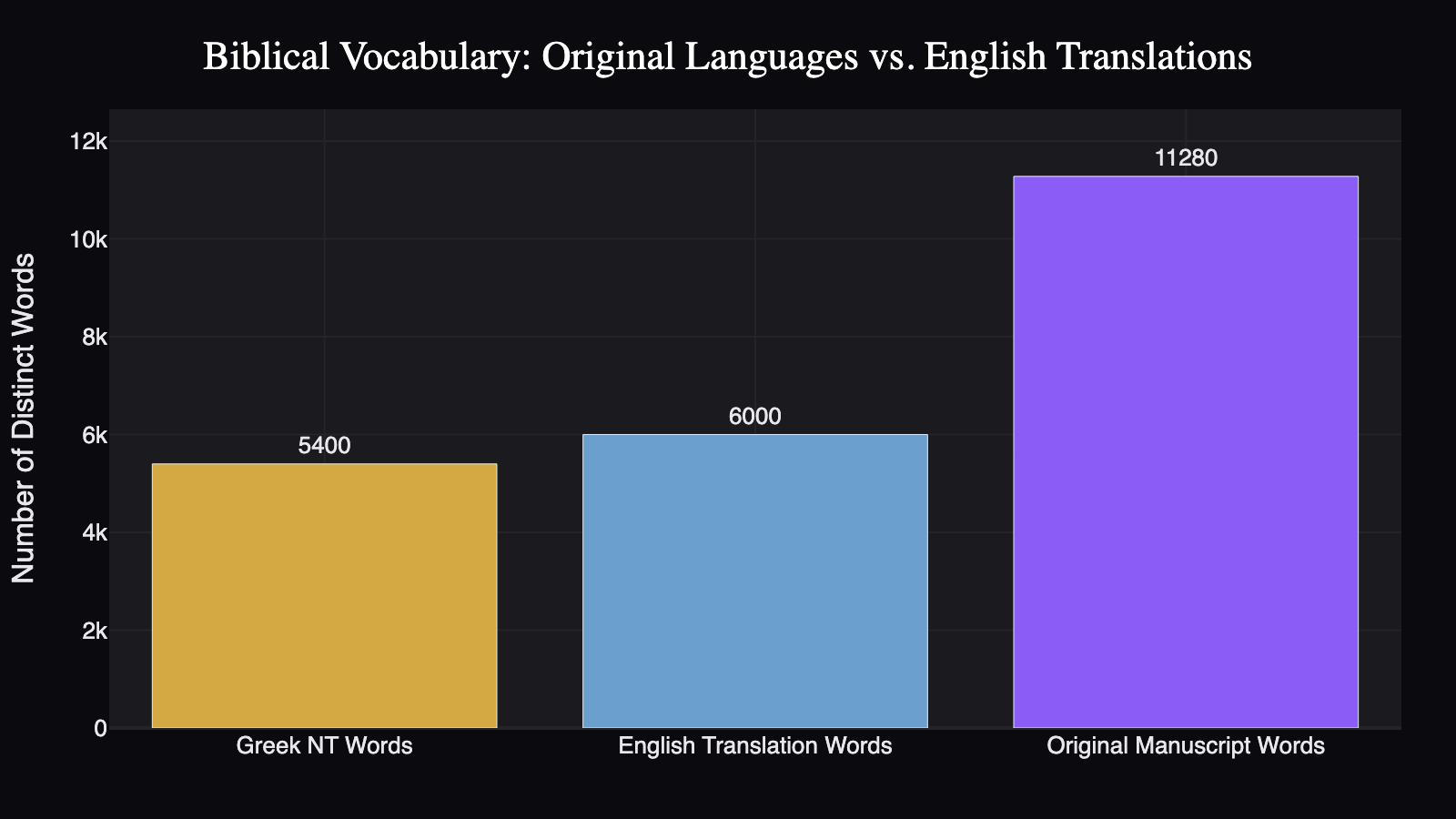
That compression is worth examining. The Greek New Testament uses around 5,400 distinct words, but a single English word like "servant" can translate up to seven different Greek words, each with distinct social, legal, and relational meaning. When you collapse those distinctions in translation, you lose data the original author was careful to give you.
ScriptureVerse's AI Bible Teacher, in the iPhone app opening February 10, 2027, is built for this kind of question. From any verse you can ask it to look at the original words or the verse's cross-references, and it shows the verses behind its answer so you can check them. It is AI and can make mistakes, so treat it as a starting point, not a lexicon. This guide covers everything else: choosing words, finding the original terms, using lexicons correctly, and avoiding the traps that derail most word studies.
Why Does a Bible Word Study Matter?
A Greek or Hebrew word study reveals meanings buried by translation, giving readers direct access to the theological precision the original authors intended.
English is a useful lens, but every translation is also an interpretation. When Paul writes in Philippians 4:13, "I can do all things through him who strengthens me," the word translated "strengthens" is the Greek endynamoo - literally "to infuse with power." That's more specific than "strengthens." It implies a source, a continuous supply, a direction of flow. Word study turns good reading into close reading.
For the Old Testament, the same principle holds in Hebrew. The word chesed (Strong's H2617) appears 248 times and is variously translated as "lovingkindness," "steadfast love," "mercy," and "loyalty" depending on the translation committee. None of those English words captures it fully - chesed carries covenantal obligation, affectionate loyalty, and unearned generosity at once.
What Tools Do You Need to Start?
The essential tools for a word study are Strong's Concordance for finding numbered root words, a lexicon for definitions, and a reliable interlinear Bible for the original text.
Here is a practical comparison of the major options:
| Tool | Type | Cost | Best For |
|---|---|---|---|
| Blue Letter Bible | Web / App | Free | Beginners: Strong's, interlinear, basic lexicon |
| Bible Hub | Web | Free | Quick lookups, Thayer's, multiple translations |
| STEP Bible | Web | Free | Academic; includes BDAG access |
| Logos Bible Software | Desktop / App | Paid | Seminary-level library, morphology search |
| Accordance | Desktop | Paid | Mac-native, fast academic search |
For most readers starting out, Blue Letter Bible covers the essentials. BDAG (Bauer-Danker-Arndt-Gingrich) for Greek and HALOT for Hebrew are the definitive scholarly lexicons - both available through STEP Bible or Logos. Kathy Howard's guide to Greek and Hebrew word study resources walks through the BLB workflow in detail for readers new to original-language tools.
How Do You Find the Original Greek or Hebrew Word?
Blue Letter Bible's interlinear tool displays each English word alongside its Strong's number and original Greek or Hebrew characters, making the lookup process accessible without language training.
Blue Letter Bible's Interlinear Help Tutorial describes the three-column display: Column 1 shows the English translation word, Column 2 shows the Strong's number as a hyperlink to the full lexicon entry, and Column 3 shows the original-language characters with transliteration. The LexiConc tool, accessible from any lexicon page, shows every occurrence of a given original-language word across the entire Bible.
Duke University's Divinity School recommends this same approach as the entry point for students without access to physical library reference rooms. The Strong's system dates to 1890 and has scholarly limitations, but it is the universal access key for readers without formal language training.
How Do You Do a Word Study, Step by Step?
A complete word study follows four phases: identify the original-language term, find its lexicon definition, trace usage across the canon, and check a theological dictionary for fuller context.
Here is the full process:
-
Choose a theologically significant word. Skip conjunctions and prepositions. Focus on nouns, verbs, and adjectives that carry doctrinal weight - "love," "grace," "repent," "holy," "faith."
-
Find the Strong's number. Open Blue Letter Bible, select the KJV translation, and click the Tools or Interlinear button above the verse list. The Strong's number appears as a blue hyperlink in the second column.
-
Read the lexicon definition. For Greek, use Thayer's (free) or BDAG (gold standard). For Hebrew, use BDB - Brown-Driver-Briggs (free) or HALOT (scholarly standard). Note the full range of meaning, not just the single gloss.
-
Study the root carefully. The word metanoeo (repentance) breaks into meta (change) + nous (mind), giving the literal sense of "change of mind." Use roots as orientation, not as definitions - and read the section below on the root fallacy before drawing conclusions from etymology.
-
Trace usage across the canon. Use the LexiConc tool to see every verse where the original word appears. Look for patterns: which authors use it most, how usage shifts between OT and NT contexts, whether the word carries consistent or varied meaning across genres.
-
Check a theological dictionary. The TDNT (Theological Dictionary of the New Testament, 10 volumes) and TDOT (Theological Dictionary of the Old Testament, 15 volumes) provide full scholarly articles on major terms. Luther Seminary's research guide identifies these as the authoritative reference sets for linguistic and historical context. STEP Bible provides access to several volumes at no cost.
-
Compare 4-6 translations. BibleGateway's side-by-side comparison shows how different translation committees handled the same word. Variation signals that translators were wrestling with the same ambiguity you are.
Pro Tip: Precept Austin's Greek word study guide and Hebrew word study guide are among the most detailed free methodology references available. The Hebrew guide walks through chesed (H2617) from start to finish - an ideal worked example to follow your first time through.
What Mistakes Do Most People Make?
The most damaging error in word study is the root fallacy: assuming a word's meaning comes from its etymological parts rather than actual usage in context.
Ekklesia (church) contains roots meaning "called out," but that etymology does not mean every occurrence of the word carries a "called-out people" emphasis. Context governs meaning; etymology informs it at best. The expert-level guide at MyBibleSong flags this as one of the most common errors at every skill level, alongside over-reliance on English synonyms.
Other traps worth knowing:
- Relying on English synonyms. Using a thesaurus to extend a word study produces circular reasoning. Trace the original word's usage, not the English translation's relatives.
- Treating Strong's as authoritative. Strong's is a reference index, not a lexicon. It points you toward the right Greek or Hebrew word; the lexicon gives the actual scholarly definition.
- Cherry-picking occurrences. If you study agape only in John 3:16 without checking 1 John 2:15 ("Do not love the world"), you'll form a narrower picture than the canon provides.
- Ignoring the Septuagint. The Greek OT often shows how NT writers understood OT Hebrew terms - a connection many introductory word study guides skip entirely.
What Words Are Worth Studying?
The most rewarding words to study are theologically loaded terms like chesed, agape, and metanoia, where one original-language word carries meaning no single English equivalent can hold.
A few starting points that repay careful attention:
- Chesed (H2617): Usually "lovingkindness" or "steadfast love." Covenantal, loyal, unearned. Central to the Psalms. Psalm 23:1 operates on a chesed understanding of God's character.
- Agape (G26): Love that is willed rather than merely felt - distinct from phileo (affectionate love). Understanding this distinction changes the weight of John 3:16.
- Metanoia (G3341): Repentance as a change of mind. Jesus' opening command in Mark 1:15 uses the present imperative plural: keep changing your minds, all of you - not a one-time event.
- Charis (G5485): Grace - unearned favor, gift, divine power. Appears 155 times in the NT. Bible verses about grace provides a cross-reference starting point.
- Emunah (H530): Faith, faithfulness, steadiness. Related to the root for "amen." Tracing emunah alongside the Greek pistis in Bible verses about faith shows how OT and NT writers drew on the same concept with slightly different emphases.
How Do Cross-References Change Word Study?
Following a word's cross-references across the Bible's 31,102 verses surfaces patterns quickly that would take hours of manual concordance work to discover.
OpenBible.info's 344,799 cross-references, drawn mainly from the Treasury of Scripture Knowledge, link those verses together. When you're studying a word like faith, you can follow it across the canon: which books return to the concept, where the OT and NT overlap, which passages are most often linked. In ScriptureVerse, each verse's study sheet lists these cross-references to tap through, and the AI Bible Teacher can explain the original words of the verse you're reading.
If you've used Logos for word studies, the comparison is worth reading: ScriptureVerse vs Logos. The tools approach the same material from opposite directions: one as a deep research library, one as an iPhone app for daily reading, prayer and questions.
Word study has always been about following threads. When you follow those threads across the full canon rather than stopping at a concordance column, the connections become intuitive rather than purely analytical. For more on cross-references as a study method, see How to Use Cross-References to Go Deeper in Scripture (2026).
 bible-vocabulary-comparison
Frequently Asked Questions
Q: Do I need to know Greek or Hebrew to do a word study?
No language knowledge is required. Strong's Concordance assigns a number to every original-language word, and tools like Blue Letter Bible and STEP Bible let you look up definitions, usage, and scholarly commentary through those numbers. You will be reading transliterations and English lexicon entries throughout the process.
Q: What is the best free tool for word studies?
Blue Letter Bible is the most widely recommended free starting point. It includes Strong's Concordance, an interlinear Bible, Thayer's Greek Lexicon, Brown-Driver-Briggs for Hebrew, and the LexiConc tool for tracing every occurrence of a given original-language word across the full canon.
Q: What is the difference between a lexicon and a theological dictionary?
A lexicon gives linguistic definitions - what a word means, its grammatical forms, and how it appears across the text. A theological dictionary like TDNT or TDOT examines a word's history across the ancient world, its use in the Septuagint, and its theological weight within both Testaments. Lexicons answer "what does this word mean?" and theological dictionaries answer "what has this word meant to believing communities across history?"
Q: What is the root fallacy?
The root fallacy is assuming a word's meaning equals the sum of its etymological parts - for instance, reasoning that "butterfly" means "a fly that eats butter." In biblical studies, it means using a compound word's component roots as its definition rather than studying how the word is actually used in context. Etymology is a starting point, not a conclusion.
Q: How long does a word study take?
A basic word study using Blue Letter Bible - find the Strong's number, read the lexicon entry, check usage across the canon - takes 20 to 30 minutes. A thorough academic study consulting BDAG or HALOT and a theological dictionary can take several hours for a single word.
Q: What Hebrew word should I study first?
Chesed (H2617) is the most commonly recommended starting point. It appears 248 times, has a rich scholarly literature, and the gap between its English renderings ("lovingkindness," "steadfast love," "mercy," "loyalty") immediately shows why word study matters. Precept Austin's Hebrew word study guide uses chesed as its full worked example.
Q: What Greek word should I study first?
Agape (G26) is a natural entry point. The NT has four Greek words for different kinds of love, and the choice between them is often theologically deliberate. The exchange in John 21:15-17 - where Jesus and Peter use different Greek words across the same conversation - is one of the most discussed word-study passages in the NT and a productive first case to work through.
Q: Can AI tools help with word studies?
Research shows roughly four in ten practicing Christians in 2026 say AI has helped them with Bible study or spiritual growth. AI tools work best when they draw on actual biblical data and cross-reference networks rather than general language model knowledge alone. ScriptureVerse's AI Bible Teacher quotes and shows the verses behind its answers so you can check them, rather than answering like a general-purpose chatbot.
ScriptureVerse is a Bible and prayer app for iPhone, opening on Ash Wednesday, February 10, 2027. Read any verse with its cross-references and commentary, follow a daily plan of scripture and prayer, and ask an AI Bible Teacher that shows the verses behind its answers. Join the waitlist →